Free PDF · Fitness
Beginner 5K Running Plan PDF (8 Weeks)
This free beginner 5K running plan takes you from run/walk intervals to 30 minutes of continuous running in 8 weeks. You run three times a week, and each session is written out in full. It also has an effort guide, warm-up and cool-down, a race-day checklist and a printable run log.
11 pages · 564 KB · PDF · Free · No sign-up to download
General information, not medical advice. Check with a doctor before you start a new exercise or diet plan if you have a health condition or injury.
What is inside
- How to use the plan and when to repeat a week
- An effort guide with the talk test
- Warm-up and cool-down routines
- The full 8-week schedule, session by session
- A one-page calendar overview
- Shoes, gear and common beginner mistakes
- A race-day checklist
- A printable run log
Who it is for: New runners, or people who return to running, who want to finish their first 5K.
Preview
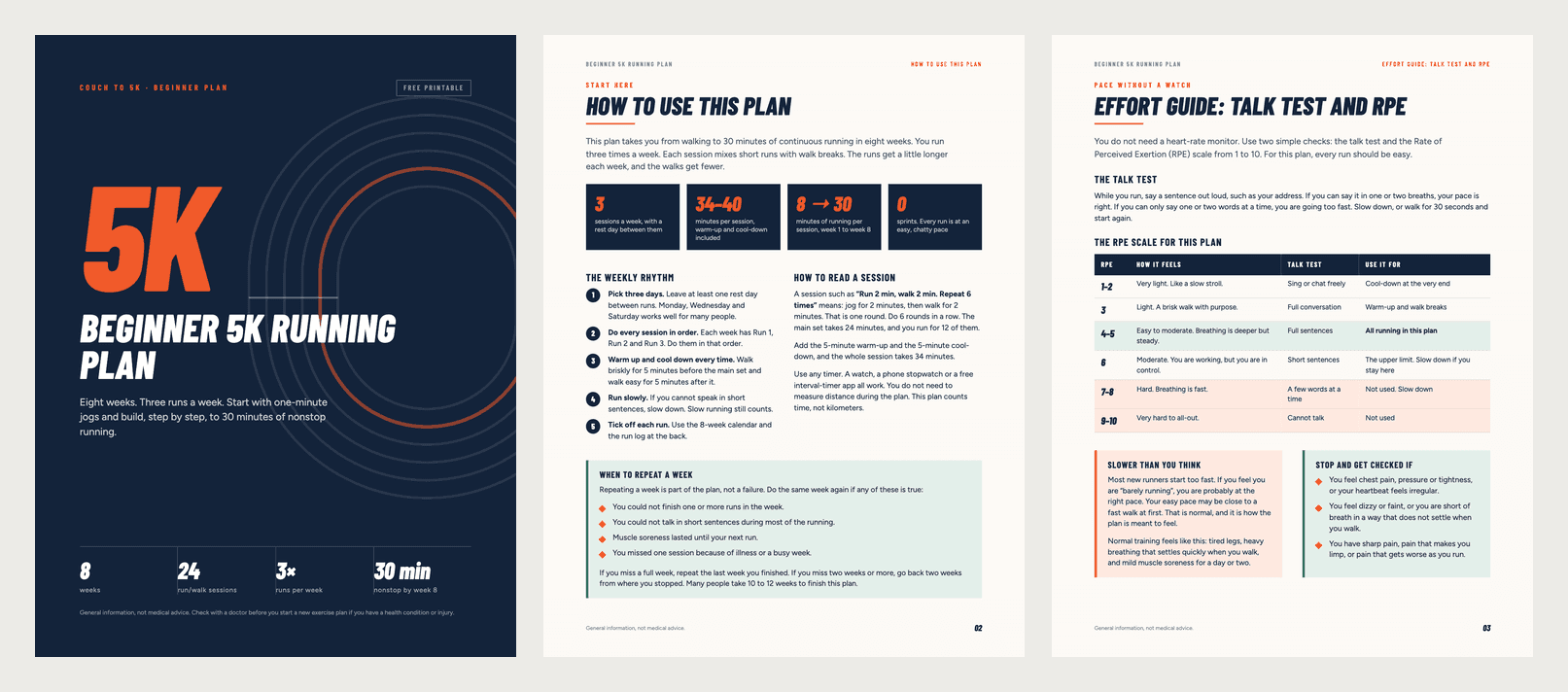
Full text of the PDF
This is the text of the PDF, so you can read it before you download. Blank log pages are not shown.
Read the full text
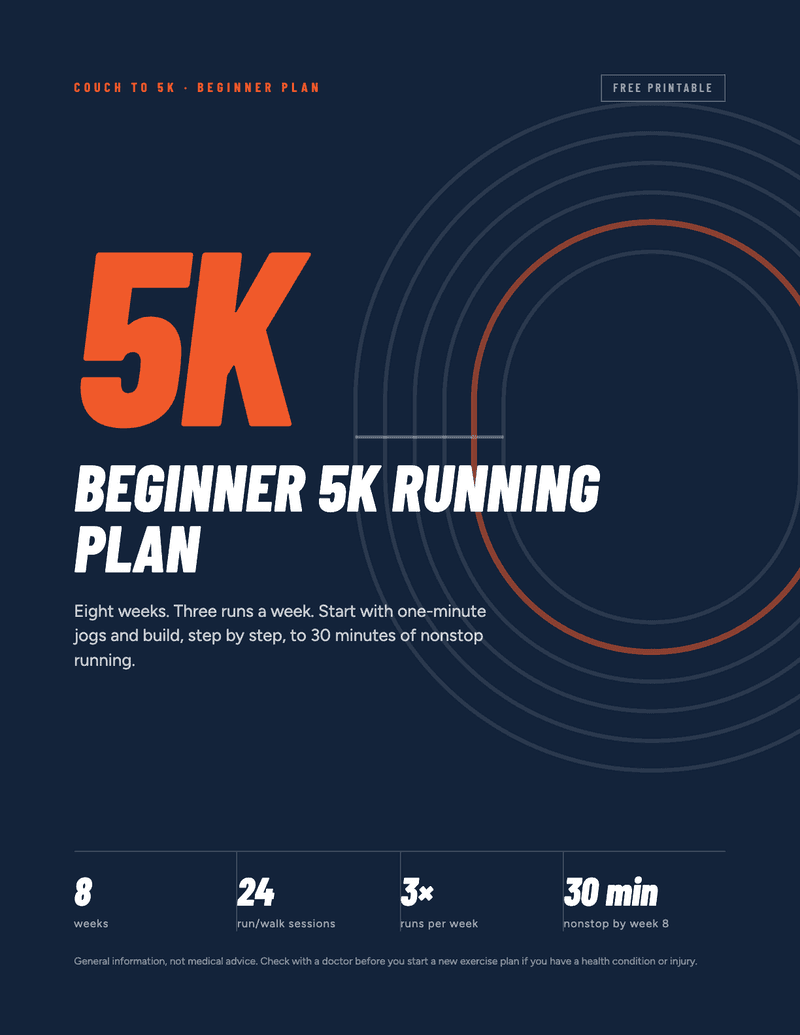
Couch to 5K · Beginner Plan
Beginner 5K Running Plan
Eight weeks. Three runs a week. Start with one-minute jogs and build, step by step, to 30 minutes of nonstop running.
8
weeks
24
run/walk sessions
3×
runs per week
30 min
nonstop by week 8
General information, not medical advice. Check with a doctor before you start a new exercise plan if you have a health condition or injury.
Start here
How to Use This Plan
This plan takes you from walking to 30 minutes of continuous running in eight weeks. You run three times a week. Each session mixes short runs with walk breaks. The runs get a little longer each week, and the walks get fewer.
3
sessions a week, with a rest day between them
34–40
minutes per session, warm-up and cool-down included
8 → 30
minutes of running per session, week 1 to week 8
0
sprints. Every run is at an easy, chatty pace
The weekly rhythm
- Pick three days. Leave at least one rest day between runs. Monday, Wednesday and Saturday works well for many people.
- Do every session in order. Each week has Run 1, Run 2 and Run 3. Do them in that order.
- Warm up and cool down every time. Walk briskly for 5 minutes before the main set and walk easy for 5 minutes after it.
- Run slowly. If you cannot speak in short sentences, slow down. Slow running still counts.
- Tick off each run. Use the 8-week calendar and the run log at the back.
How to read a session
A session such as “Run 2 min, walk 2 min. Repeat 6 times” means: jog for 2 minutes, then walk for 2 minutes. That is one round. Do 6 rounds in a row. The main set takes 24 minutes, and you run for 12 of them.
Add the 5-minute warm-up and the 5-minute cool-down, and the whole session takes 34 minutes.
Use any timer. A watch, a phone stopwatch or a free interval-timer app all work. You do not need to measure distance during the plan. This plan counts time, not kilometers.
When to repeat a week
Repeating a week is part of the plan, not a failure. Do the same week again if any of these is true:
- You could not finish one or more runs in the week.
- You could not talk in short sentences during most of the running.
- Muscle soreness lasted until your next run.
- You missed one session because of illness or a busy week.
If you miss a full week, repeat the last week you finished. If you miss two weeks or more, go back two weeks from where you stopped. Many people take 10 to 12 weeks to finish this plan.
Pace without a watch
Effort Guide: Talk Test and RPE
You do not need a heart-rate monitor. Use two simple checks: the talk test and the Rate of Perceived Exertion (RPE) scale from 1 to 10. For this plan, every run should be easy.
The talk test
While you run, say a sentence out loud, such as your address. If you can say it in one or two breaths, your pace is right. If you can only say one or two words at a time, you are going too fast. Slow down, or walk for 30 seconds and start again.
The RPE scale for this plan
| RPE | How it feels | Talk test | Use it for |
|---|---|---|---|
| 1–2 | Very light. Like a slow stroll. | Sing or chat freely | Cool-down at the very end |
| 3 | Light. A brisk walk with purpose. | Full conversation | Warm-up and walk breaks |
| 4–5 | Easy to moderate. Breathing is deeper but steady. | Full sentences | All running in this plan |
| 6 | Moderate. You are working, but you are in control. | Short sentences | The upper limit. Slow down if you stay here |
| 7–8 | Hard. Breathing is fast. | A few words at a time | Not used. Slow down |
| 9–10 | Very hard to all-out. | Cannot talk | Not used |
Slower than you think
Most new runners start too fast. If you feel you are “barely running”, you are probably at the right pace. Your easy pace may be close to a fast walk at first. That is normal, and it is how the plan is meant to feel.
Normal training feels like this: tired legs, heavy breathing that settles quickly when you walk, and mild muscle soreness for a day or two.
Stop and get checked if
- You feel chest pain, pressure or tightness, or your heartbeat feels irregular.
- You feel dizzy or faint, or you are short of breath in a way that does not settle when you walk.
- You have sharp pain, pain that makes you limp, or pain that gets worse as you run.
Every session
Warm-Up and Cool-Down
The warm-up prepares your joints and raises your heart rate slowly. The cool-down lets your breathing settle before you stop. Both take about 5 minutes and both are part of every session.
Warm-up · 5 minutes
| Move | Amount |
|---|---|
| Brisk walk, arms swinging (RPE 3) | 3 min |
| Leg swings, front to back, hold a wall | 10 each leg |
| Leg swings, side to side | 10 each leg |
| Ankle circles | 10 each way |
| Walking lunges, small and controlled | 6 each leg |
| Marching high knees | 20 sec |
The moves after the walk take about 2 minutes. Keep them gentle. They wake up the muscles. They are not a workout.
Cool-down · 5 minutes
| Move | Amount |
|---|---|
| Easy walk (RPE 1–2) | 5 min |
| Calf stretch against a wall | 20–30 sec each |
| Standing quad stretch | 20–30 sec each |
| Hamstring stretch, heel on a low step | 20–30 sec each |
| Hip flexor stretch, half kneel | 20–30 sec each |
The stretches are optional and come after the 5-minute walk. Hold each one still. Do not bounce. Stretch to mild tension, never to pain.
Good running form, kept simple
- Stand tall. Look ahead, not at your feet. Keep your shoulders low and loose.
- Take short, quick steps. Land with your foot under your body, not far in front of it.
- Relax your hands. Hold them as if you carry a crisp you do not want to break.
- Breathe naturally. Breathe through your mouth and nose together. Do not hold your breath.
The schedule · Part 1
The 8-Week Schedule: Weeks 1–4
Every session starts with the 5-minute warm-up and ends with the 5-minute cool-down. The “Main set” column shows what to do between them. “Running” is the total time you spend running. “Session” is the full time, warm-up and cool-down included.
| Week | Run | Main set | Running | Session |
|---|---|---|---|---|
| 01 Learn the rhythm | Run 1 | Run 1 min, walk 2 min. Repeat 8 times (24 min). | 8 min | 34 min |
| Run 2 | Run 1 min, walk 2 min. Repeat 8 times (24 min). | 8 min | 34 min | |
| Run 3 | Run 1 min, walk 2 min. Repeat 8 times (24 min). | 8 min | 34 min | |
| 02 Double the run | Run 1 | Run 2 min, walk 2 min. Repeat 6 times (24 min). | 12 min | 34 min |
| Run 2 | Run 2 min, walk 2 min. Repeat 6 times (24 min). | 12 min | 34 min | |
| Run 3 | Run 2 min, walk 2 min. Repeat 6 times (24 min). | 12 min | 34 min | |
| 03 Longer runs, same walks | Run 1 | Run 3 min, walk 2 min. Repeat 5 times (25 min). | 15 min | 35 min |
| Run 2 | Run 3 min, walk 2 min. Repeat 5 times (25 min). | 15 min | 35 min | |
| Run 3 | Run 4 min, walk 2 min. Repeat 4 times (24 min). | 16 min | 34 min | |
| 04 Five-minute runs | Run 1 | Run 5 min, walk 2 min. Repeat 4 times (28 min). | 20 min | 38 min |
| Run 2 | Run 5 min, walk 2 min. Repeat 4 times (28 min). | 20 min | 38 min | |
| Run 3 | Run 5 min, walk 2 min. Repeat 4 times (28 min). | 20 min | 38 min |
Coach’s note for weeks 1–4
The first four weeks build the habit and prepare your legs, tendons and joints. Week 4 has the same session three times on purpose. If the 5-minute runs feel hard, do week 4 again before you move on.
The schedule · Part 2
The 8-Week Schedule: Weeks 5–8
From week 5 the walk breaks get fewer. In week 7 you run without a walk break for the first time. Keep the same easy pace as in week 1. The runs are longer, not faster.
| Week | Run | Main set | Running | Session |
|---|---|---|---|---|
| 05 Three long blocks | Run 1 | Run 8 min, walk 2 min. Repeat 3 times (30 min). | 24 min | 40 min |
| Run 2 | Run 8 min, walk 2 min. Repeat 3 times (30 min). | 24 min | 40 min | |
| Run 3 | Run 12 min, walk 2 min, run 12 min (26 min). | 24 min | 36 min | |
| 06 One walk break | Run 1 | Run 12 min, walk 2 min, run 12 min (26 min). | 24 min | 36 min |
| Run 2 | Run 15 min, walk 2 min, run 10 min (27 min). | 25 min | 37 min | |
| Run 3 | Run 18 min, walk 2 min, run 8 min (28 min). | 26 min | 38 min | |
| 07 First nonstop runs | Run 1 | Run 20 min, walk 2 min, run 6 min (28 min). | 26 min | 38 min |
| Run 2 | Run 22 min without stopping. | 22 min | 32 min | |
| Run 3 | Run 25 min without stopping. | 25 min | 35 min | |
| 08 30 minutes | Run 1 | Run 26 min without stopping. | 26 min | 36 min |
| Run 2 | Run 28 min without stopping. | 28 min | 38 min | |
| Run 3 | Run 30 min without stopping. You did it. | 30 min | 40 min |
Minutes of running in each of the 24 sessions. The total rises from 8 minutes in week 1 to 30 nonstop minutes in week 8.
Print and stick on the fridge
8-Week Calendar Overview
This calendar uses Monday, Wednesday and Saturday as run days. You can move the days. Keep at least one rest day between runs. Tick the box after each run.
| Wk | Mon | Tue | Wed | Thu | Fri | Sat | Sun |
|---|---|---|---|---|---|---|---|
| 1 | Run 1 Run 1 / walk 2, ×8 | Rest | Run 2 Run 1 / walk 2, ×8 | Rest | Rest or walk | Run 3 Run 1 / walk 2, ×8 | Rest |
| 2 | Run 1 Run 2 / walk 2, ×6 | Rest | Run 2 Run 2 / walk 2, ×6 | Rest | Rest or walk | Run 3 Run 2 / walk 2, ×6 | Rest |
| 3 | Run 1 Run 3 / walk 2, ×5 | Rest | Run 2 Run 3 / walk 2, ×5 | Rest | Rest or walk | Run 3 Run 4 / walk 2, ×4 | Rest |
| 4 | Run 1 Run 5 / walk 2, ×4 | Rest | Run 2 Run 5 / walk 2, ×4 | Rest | Rest or walk | Run 3 Run 5 / walk 2, ×4 | Rest |
| 5 | Run 1 Run 8 / walk 2, ×3 | Rest | Run 2 Run 8 / walk 2, ×3 | Rest | Rest or walk | Run 3 Run 12 / walk 2 / run 12 | Rest |
| 6 | Run 1 Run 12 / walk 2 / run 12 | Rest | Run 2 Run 15 / walk 2 / run 10 | Rest | Rest or walk | Run 3 Run 18 / walk 2 / run 8 | Rest |
| 7 | Run 1 Run 20 / walk 2 / run 6 | Rest | Run 2 Run 22 min nonstop | Rest | Rest or walk | Run 3 Run 25 min nonstop | Rest |
| 8 | Run 1 Run 26 min nonstop | Rest | Run 2 Run 28 min nonstop | Rest | Rest or walk | Run 3 Run 30 min nonstop | Rest |
All times are in minutes. Every run day also includes the 5-minute warm-up and the 5-minute cool-down. “Rest or walk” means an optional easy walk of 20 to 30 minutes.
Keep it simple
Shoes and Gear Basics
You need very little to start. A good pair of running shoes matters most. Everything else is about comfort and safety.
Running shoes
- Buy running shoes, not general trainers. Running shoes have cushioning made for repeated landings.
- Choose comfort first. The right shoe feels good the moment you put it on. Do not expect a shoe to “break in”.
- Leave a thumb’s width between your longest toe and the end of the shoe. Feet swell a little as you run.
- Shop later in the day, when your feet are at their largest. Wear the socks you will run in.
- Try a short jog in the store if it allows it. Many running stores do.
- Track your shoe mileage. A common guide is to replace shoes every 300 to 500 miles (about 500 to 800 km), or sooner if the cushioning feels flat.
Clothing
- Socks: synthetic or wool running socks. Cotton holds sweat and can cause blisters.
- Top and shorts or leggings: light, moisture-wicking fabric.
- Sports bra: a well-fitted, high-support bra if you need one.
- Dress for 10°F (about 5°C) warmer than the actual temperature. You will warm up within a few minutes.
Useful extras
- Timer: a basic watch or a free interval-timer app.
- Water: drink before and after. For sessions under 45 minutes, most people do not need to carry water unless it is hot.
- Visibility: a reflective vest or a small light for early mornings and evenings.
- ID: carry your phone or an ID card with an emergency contact.
Where to run
Choose a flat, safe route for the first weeks: a park loop, a quiet road with a sidewalk, or a school track. A treadmill works too. Set it to a 1% incline to make it feel closer to outdoor running. Save hills for later.
Learn from others
Common Beginner Mistakes
Most beginners who stop a plan do so for the same few reasons. Each one has an easy fix.
Running too fast
Fast running makes every interval feel like a fight. Use the talk test. If you cannot speak in sentences, slow down until you can.
Skipping rest days
Your body adapts on rest days, not during the run. Keep at least one day between runs, even when you feel great.
Jumping ahead
Do not skip weeks or add extra runs. Muscles adapt faster than tendons and bones. A slow build lets them catch up.
Running through pain
Muscle tiredness is normal. Sharp pain, pain that makes you limp or pain that gets worse is not. Stop, rest, and get it checked if it does not settle.
Long, reaching strides
Big steps make your foot land far in front of your body. Take shorter, quicker steps and land under your hips.
Skipping the warm-up
The first minutes of running feel hardest when you start cold. Five minutes of brisk walking makes the first interval much easier.
Comparing your pace
Your pace is yours. This plan measures time on your feet. A 30-minute run at any speed is the goal.
Seeing a repeat as a failure
Repeating a week is normal. Steady progress over 10 or 12 weeks is better than an injury in week 5.
From 30 minutes to 5K
At the end of the plan you can run for 30 minutes. Some people cover 5 km (3.1 miles) in that time. Many need 35 to 45 minutes. Both are fine. To finish your first 5K, run at your easy pace and take a short walk break if you need one. Walk breaks are allowed in almost every 5K event.
Your first 5K
Race-Day Checklist
A first 5K is a celebration, not a test. Plan ahead so the day feels calm. Nothing new on race day: no new shoes, no new clothes, no new breakfast.
The week before
- Do your normal runs but keep them easy. Do not try a hard run this week.
- Read the event information: start time, start location, parking and bag drop.
- Collect your race bib if the event asks you to do it in advance.
- Plan how you get to the start. Aim to arrive 45 to 60 minutes early.
The night before
- Lay out your clothes, shoes, socks and race bib.
- Pin the bib to the front of your top with four safety pins.
- Charge your phone or watch.
- Eat a normal dinner that you know agrees with you.
- Set two alarms and go to bed at your usual time.
Race morning
- Eat a light, familiar breakfast 2 to 3 hours before the start.
- Drink water as normal. Do not drink a lot more than usual.
- Use the bathroom before you leave and again at the venue.
- Do your usual 5-minute warm-up about 15 minutes before the start.
- Start near the back of the group. It is calmer there.
During and after
- Start slower than you want to. The first kilometer should feel easy.
- Use the talk test. Walk for a minute if you need to, then run again.
- Keep walking for 5 minutes after the finish line.
- Drink water and eat a snack within an hour.
- Write your time in the run log. It is your first 5K record.
What to pack
Race bib and pins, phone, house key, a light layer to wear before the start, a water bottle, a small snack, and dry clothes for the trip home.
After the plan
Keep running three times a week to hold your fitness. When 30 minutes feels comfortable, you can add 2 to 3 minutes to one run each week, or start a plan for a faster 5K or a 10K.
Make your own version
Open this design in BuildPDFs, describe your changes (your plan, your brand, your words) and download a new designed PDF.
Based on the Fitness & Wellness Guide template.
Frequently asked questions
Can a beginner run a 5K in 8 weeks?
Many beginners can. This plan starts with short run intervals and walking breaks and builds to 30 minutes of running. If a week feels too hard, repeat it before you move on.
How many days a week do I run?
Three days a week, with a rest day or an easy walk between runs.
How fast should I run?
Slow enough to talk in short sentences. The PDF has an effort guide that uses this talk test.
Can I make a running plan for my own running club?
Yes. Open it in BuildPDFs, describe your club, distance and weeks, and download a new designed PDF.