Free PDF · Publishing
eBook Sample Chapter Example (PDF)
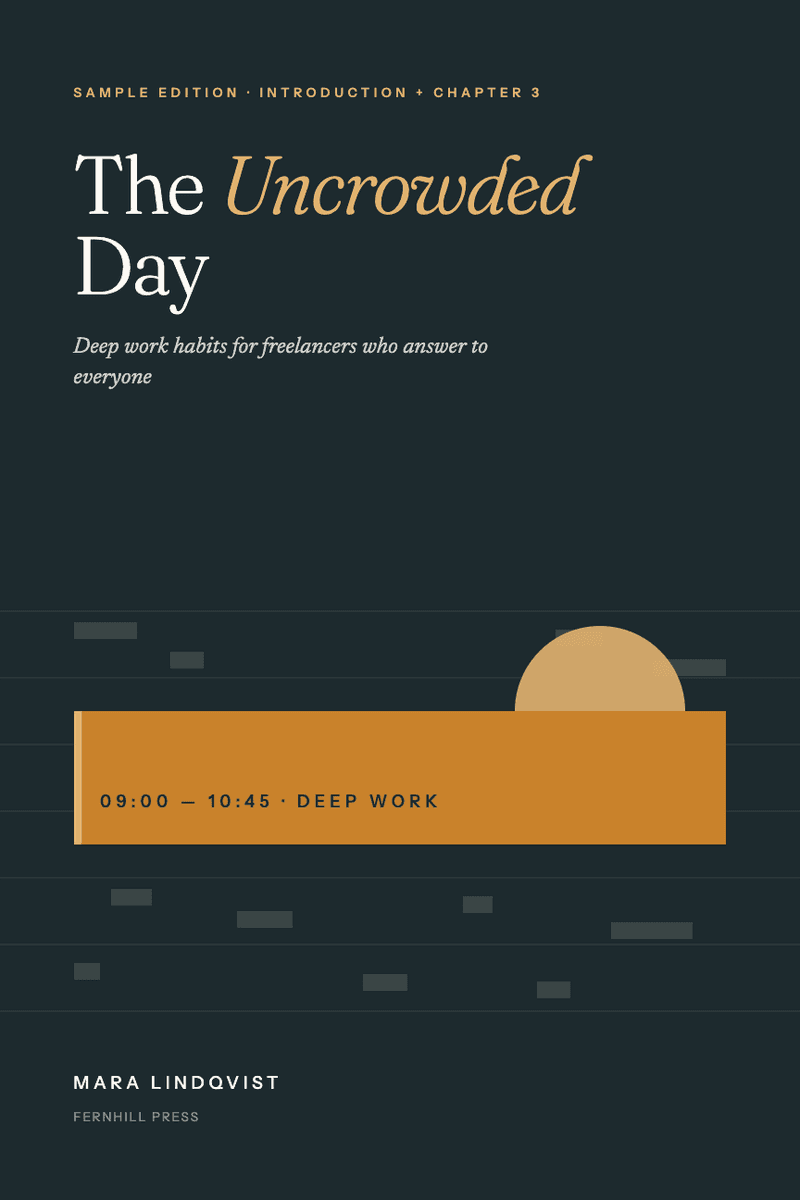
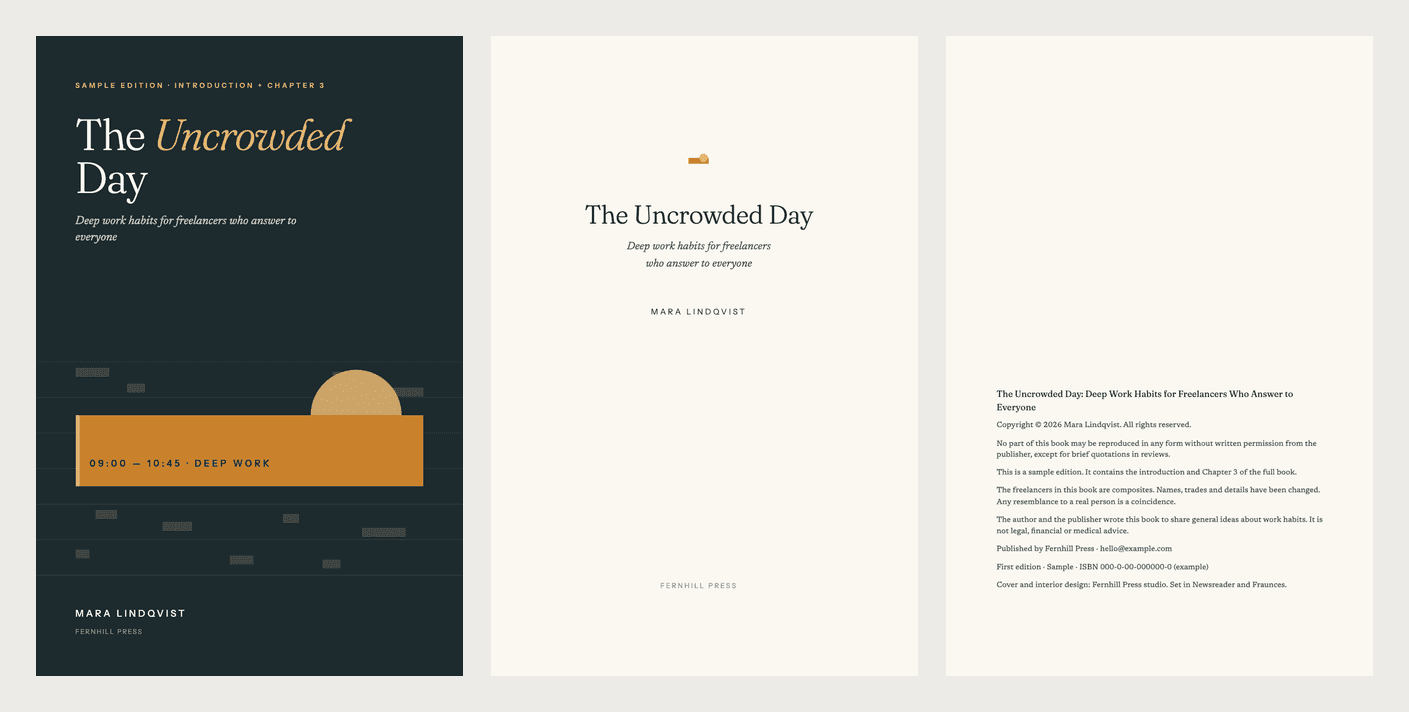
This free ebook sample shows how a finished nonfiction ebook looks as a PDF. It has a designed cover, a copyright page, a table of contents for the full book, an introduction and one complete chapter. The chapter has subheads, a pull quote, a callout box, a chart and key takeaways.
18 pages · 851 KB · PDF · Free · No sign-up to download
What is inside
- A designed cover
- A copyright and front matter page
- A table of contents for the full book
- An introduction
- One complete sample chapter
- A pull quote, a callout box and a chart
- Chapter key takeaways
- About the author
Who it is for: Authors, coaches and creators who plan an ebook and want to see a finished layout.
Preview
Full text of the PDF
This is the text of the PDF, so you can read it before you download. Blank log pages are not shown.
Read the full text
Sample edition · Introduction + Chapter 3
The Uncrowded Day
Deep work habits for freelancers who answer to everyone
Mara Lindqvist
Fernhill Press
The Uncrowded Day
Deep work habits for freelancers who answer to everyone
Mara Lindqvist
Fernhill Press
The Uncrowded Day: Deep Work Habits for Freelancers Who Answer to Everyone
Copyright © 2026 Mara Lindqvist. All rights reserved.
No part of this book may be reproduced in any form without written permission from the publisher, except for brief quotations in reviews.
This is a sample edition. It contains the introduction and Chapter 3 of the full book.
The freelancers in this book are composites. Names, trades and details have been changed. Any resemblance to a real person is a coincidence.
The author and the publisher wrote this book to share general ideas about work habits. It is not legal, financial or medical advice.
Published by Fernhill Press · hello@example.com
First edition · Sample · ISBN 000-0-00-000000-0 (example)
Cover and interior design: Fernhill Press studio. Set in Newsreader and Fraunces.
Contents
- Introduction: Nobody Is Coming to Protect Your Time
- 01 The Always-Available TrapNot in this sample
- 02 What a Switch Really CostsNot in this sample
- 03 The Anchor Block
- 04 Office Hours for ClientsNot in this sample
- 05 The Inbox Is Not a To-Do ListNot in this sample
- 06 Shallow Work, Done WellNot in this sample
- 07 Pricing for FocusNot in this sample
- 08 Rest Is Part of the WorkNot in this sample
- 09 The Uncrowded YearNot in this sample
- About the Author
The full book also includes an afterword, a set of planning worksheets and notes.
Introduction
Nobody Is Coming to Protect Your Time
When I left my agency job to work for myself, I made a list of everything I would no longer have to put up with. Open-plan noise. Status meetings that could have been two lines in a document. A manager who booked over my lunch. I pinned the list above my new desk, in my new spare room, and I felt free.
Within six months my days were more broken than they had ever been. The meetings were gone, but something faster had replaced them. I had five clients, and each of them could reach me on three channels. Each of them, quite reasonably, thought of me as part of their team. None of them knew about the other four. My phone became a small office with no door, and I sat in it from breakfast until late at night.
The work still got done, mostly. But it got done in the evenings, in the gaps, in a rush before each deadline. The part of the job I had loved, the long stretch where a hard problem slowly comes into focus, almost disappeared. I was busy all day and proud of almost nothing I made.
If you have picked up this book, I suspect some of that sounds familiar.
The problem is structural, not personal
For a long time I treated this as a discipline problem. I tried apps that blocked websites. I tried waking up at five. I tried to be the kind of person who simply does not check email. Each fix worked for about a week, and then a client needed something, and I was back where I started.
What I eventually understood is that an employee’s focus is protected, badly but really, by the structure around them. There is a manager who decides priorities. There are colleagues who absorb some of the requests. There is a building that closes. A freelancer has none of that. Every request arrives at the same desk, and every request is from someone who pays you. Nobody filters, nobody says “not now”, and nobody turns off the lights.
So the structure has to be built on purpose, by you, and it has to be strong enough to hold when a good client asks for something on a Tuesday morning. That is what this book is about.
What this book is, and what it is not
This is not a book about doing more. Most freelancers I know do plenty. It is a book about protecting the few hours a week in which your best work happens, and about arranging everything else so that it supports those hours instead of eating them.
The ideas here come from my own practice over many years, and from long conversations with designers, translators, developers, writers, illustrators and consultants who work alone. I have changed their names and details. I have not tried to dress their habits up as science. Where something is my opinion, I will say so. Where a habit worked for some people and failed for others, I will tell you that too.
The book moves from the inside out. The first two chapters look at why constant availability feels necessary, and at what each interruption really costs you. Chapter 3, the one included in this sample, describes the single habit that changed my working life more than any other: the anchor block. The later chapters build around it. They cover client office hours, a calmer way to handle the inbox, how to do shallow work well instead of resenting it, how to price so that focus is affordable, and how to rest without guilt.
How to read it
You do not need to adopt everything. Try one idea for two weeks. Keep what works and drop what does not. Freelancers are a varied bunch, and a habit that suits a novelist may be useless to someone who runs live events. The point is not to copy my week. It is to give you the tools to design your own, on purpose, instead of letting it be designed by whoever messages you first.
Nobody is coming to protect your time. The good news is that you do not need anyone to. You need a few clear rules, a little courage the first time you use them, and a day with room in it.
Mara Lindqvist
Chapter Three
The Anchor Block
One protected stretch a day, at the same time, for the work that matters most.
Elena translates technical manuals from German and Spanish into English. When I first met her, she described her days as “a pile of small fires”. She had four regular clients, each of whom sent short urgent jobs between the long ones. She answered each new message within minutes, because speed was part of her reputation. And every month she found herself, on the last two nights before a big deadline, translating until two in the morning.
Her solution was not a new tool or a new client policy. It was a block of time. Every working day, from nine until a quarter to eleven, she closed her email, put her phone in the kitchen and worked on the largest project she had. That was all. The rest of her day stayed as messy as before.
Three months later she told me the late nights had almost stopped. The big jobs were moving forward a little every morning, so they no longer piled up at the end. Her clients had not noticed any change, except that one of them commented that her long translations seemed more consistent. She had not become a different person. She had given her most important work a fixed place to live.
I call that place the anchor block.
What an anchor block is
An anchor block is a stretch of between 90 minutes and two hours, at the same time on every working day, in which you do one piece of demanding work and nothing else. No messages, no calls, no “quick checks”. It is the fixed point that the rest of your day arranges itself around, in the way a boat swings on its anchor but does not drift away.
Each part of that definition matters, so let me take them one at a time.
Between 90 minutes and two hours. This range comes from experience, not from a laboratory. Most people I have worked with need twenty or thirty minutes to settle into hard work: to reload the problem, reread where they stopped and stop thinking about the last email. A block of an hour leaves only half an hour of real depth. A block of three or four hours is wonderful when you can get it, but it is hard to protect every day, and a habit that breaks every other day is not a habit. Ninety minutes to two hours is long enough to get deep and short enough to defend.
At the same time on every working day. This is the part people most want to skip, and it is the part that makes the method work. When the block moves around, every day starts with a negotiation: when shall I do my deep work today? That question gets answered by whatever is loudest. When the block has a fixed time, the question is already answered. You do not need willpower to start. You only need to look at the clock.
One piece of demanding work. Not “work on clients”. One project, one chapter, one design, one stubborn bug. Choosing it in advance is a large part of the value, as we will see.
Nothing else. An anchor block with your inbox open in another tab is not an anchor block. It is a normal morning with good intentions.
A block you protect four days a week beats a perfect schedule you keep for one.
Choosing your time
The right time for your anchor block depends on two things: when your mind is at its best, and when the outside world is quietest. Ideally, those overlap.
Start with your own energy. Most people know, roughly, when in the day they think most clearly. For many it is the first part of the morning. For some it is late afternoon, or even the evening. Do not choose a time because a productivity book told you that successful people work at dawn. Choose the time when hard problems feel slightly easier than usual.
Then look at your clients. If most of them are in your time zone and start work at nine, the first hour of their day is often their busiest for sending requests. A block from nine to eleven means that those requests arrive while you are away, and they are waiting for you, sorted and complete, when you come out. Some freelancers prefer to start the block earlier, at seven or eight, so that it ends before clients are fully awake. If your clients are several hours ahead of you or behind you, the quiet window may fall somewhere else entirely. Look at when messages actually arrive over a normal week, and put the block in the calmest stretch that overlaps with your best hours.
Finally, think about your household. A block that collides with the school run every Thursday will fail every Thursday. It is better to choose a slightly worse time that you can keep than a perfect time that you cannot.
Figure 3.1 One way to build a day around an anchor block. The block comes first and stays fixed. The client windows and steady work fit around it, and can move from day to day.
What belongs in the block
Not every task deserves your best two hours. The anchor block is for work that has three qualities: it is hard, it is important, and it gets worse when it is interrupted. A first draft. A new layout. The architecture of a feature. The tricky middle section of a long translation. These are tasks where an interruption does not just cost you the minutes it takes; it costs you the whole structure you were holding in your head.
Many other tasks feel important but do not need depth. Invoicing, scheduling, small revisions, replying to a long but simple email, exporting files in six formats. These matter, and they must be done well, but they survive interruption. They belong in the rest of the day. We will look at how to do them with care, and even some pleasure, in Chapter 6.
A useful test is to ask: if I were interrupted every ten minutes while doing this, would the result be worse, or only slower? If only slower, it does not belong in the anchor block.
Sometimes the most important task on your list is one you are avoiding. It is vague, or uncomfortable, or you are not sure how to begin. That task is often the best candidate of all. The block gives it a fixed time and a closed door, which is exactly what an avoided task needs. You do not have to finish it. You only have to sit with it for ninety minutes, and most avoided tasks shrink a great deal once you have done that.
One more point. The block is for client work as much as for your own projects. Some freelancers assume deep work means a personal novel or a passion project, squeezed in before the “real” work begins. That can be lovely, but for most of us the hardest and most valuable work is the client work itself. The anchor block is how you give your clients your best thinking, rather than whatever is left after the messages.
The night-before rule
The most common way an anchor block fails is not an interruption. It is a slow start. You sit down at nine, open your project, and spend twenty minutes deciding what to work on. By the time you have chosen, the urge to “just check” something has crept back in, and half the block is gone.
The fix is simple. At the end of each working day, decide what tomorrow’s block is for, and write down the very first step. Not “work on the Halvorsen report”, but “rewrite the opening of section four so that it leads with the cost figures”. Put that note somewhere you will see it before you see anything else: on paper on your keyboard, or as the first line of the file you will open.
This does two things. It removes the decision from the moment when you are most likely to dodge it. And it lets the problem sit in the back of your mind overnight. Many people find that they arrive at the block with half an idea already formed.
A related habit is the stopping note. When the block ends, before you open your email, take two minutes to write where you stopped and what you were about to do next. Hemingway is often quoted as saying he liked to stop while he still knew what came next. Whether or not he said it, the advice is sound. A stopping note is a gift to tomorrow’s version of you, who will otherwise spend the first fifteen minutes trying to remember.
The anchor block rules
- Fixed time. Same start time every working day. Write it in your calendar as a repeating event.
- One task, chosen the night before, with the first step written down.
- No inputs. Email closed, chat closed, notifications off. Phone in another room, not just face down.
- Reference only. If you must go online for research, look up only what the task needs, then come back.
- A stopping note at the end, before you open anything else.
- Never miss twice. If a block breaks, the next one is non-negotiable.
Telling your clients
Many freelancers resist the anchor block because they are afraid of their clients’ reaction. What if something urgent comes in? What if they think I am slow? What if they go to someone who answers immediately?
These are real concerns, and I do not want to wave them away. But it helps to look at what clients actually value. In my experience, and in the experience of nearly every freelancer I interviewed for this book, clients care about two things far more than speed of reply. They want to know when they will hear back, and they want the work to be good. A reply that arrives at a predictable time is more reassuring than one that sometimes arrives in two minutes and sometimes in two days.
So tell them. You do not need to explain your whole philosophy. A short, friendly note is enough. Here is one version you can adapt:
Hi Sam, a small change to how I work, so you know what to expect.
Every weekday from 9:00 to 10:45 I do focused work on client projects, including yours, with email and phone off. I reply to all messages from 11:00 onward, and again in the late afternoon.
If something is truly urgent, call me on 555-0148 and I will see it at the end of the block.
Notice what this does. It frames the block as something that benefits the client, which it does. It sets a clear expectation for replies. And it gives a real emergency route, which almost nobody uses. When a client knows they can reach you in a crisis, they relax about the ordinary waiting.
Elena sent a version of this message to her four clients. Three replied with a thumbs-up. The fourth asked whether she could make an exception on the days they sent large files, and she offered to check for new files once at ten. Within a month, even that client had stopped asking.
Some clients will not accept any delay. If a client truly needs you to respond within minutes, all day, then that is a different job, closer to being on call, and it should be priced like one. We will come back to this in Chapter 7.
When the block breaks
It will break. A child will be ill. A server will go down. A client you cannot afford to lose will phone at 9:15 with a real crisis. The anchor block is not a vow. It is a default, and defaults are allowed to bend.
What matters is what happens next. The most useful rule I know is to never miss twice. One broken block is an accident. Two in a row is the start of a new habit, and that habit is having no block at all. So when Tuesday’s block breaks, Wednesday’s becomes the most protected two hours of your week. If you need to, move a call or decline a small job to keep it.
It also helps to separate a broken block from a bad one. Some days you will sit through the whole block and produce very little. The words will not come, the design will look wrong, the code will refuse to compile. That is not a failure of the method. Deep work has bad days, just as running has slow runs. A bad block still counts, because you showed up at the right time and kept the door shut. The habit is the thing you are building. Good output follows from the habit over weeks, not from any single morning.
One block or two?
Once the first block is working, many people ask whether they should add a second one in the afternoon. My advice is to wait. Run the single block for at least a month first, until it feels normal and your clients have adjusted.
After that, a second, shorter block can work well, especially for people whose energy returns later in the day. Keep it smaller, perhaps an hour, and give it a different kind of work: editing rather than drafting, or planning rather than building. Two full-length blocks every day is a heavy load for most people, and it leaves little room for the client work that pays for everything else. More is not always better. A day with one deep block and calm, well-organized shallow work is a very good day.
Measuring it, gently
You do not need a spreadsheet to know whether the anchor block is working. But a small record helps, especially in the first few weeks, when it is easy to feel that nothing has changed.
Keep a simple tally. Each working day, mark whether the block happened and whether it held: did you keep the inputs out for the whole time? At the end of each week, count. Do not count hours or words. Count blocks. Four kept blocks out of five is an excellent week. Three is a good one. If you find yourself at one or two for several weeks in a row, something in the design is wrong, and that is useful to know. Perhaps the time is wrong, or a particular client keeps breaking in, or the task you choose is too vague to start.
Then look at the bigger picture once a month. Are the late nights fewer? Are the big projects moving before the last week? Do you feel, at the end of the day, that you made something? Those are the measures that matter. They are harder to put in a chart, but you will know.
The quiet change
The anchor block is not dramatic. It does not require a new app, a new office or a new personality. From the outside, it looks like almost nothing: a person sitting at a desk for two hours with the phone in another room.
From the inside, it changes the shape of the whole day. The most important work has a home, so it stops chasing you into the evening. The small requests have a place too, so they stop feeling like intrusions. And there is a moment, most mornings, when the problem in front of you comes into focus and the rest of the world goes quiet. For many of us, that moment is why we chose this work in the first place.
In the next chapter, we will turn to the other side of the day and look at client office hours: how to make yourself reliably available at the times you choose, so that being unavailable the rest of the time feels fair to everyone.
Key takeaways
- An anchor block is 90 minutes to two hours of single-task, no-input work at the same time every working day.
- A fixed time removes the daily negotiation about when to do deep work.
- Choose the time by your energy first, then by when client messages are quietest, then by what your household allows.
- Choose tomorrow’s task and its first step the night before. End each block with a stopping note.
- Tell clients when you reply, not why. Give them a real emergency route.
- Never miss twice. A bad block still counts. Measure kept blocks, not hours.
About the Author
Mara Lindqvist is a fictional author created for this sample ebook. In the world of the book, she spent eight years as a designer at a branding agency before going freelance, and has worked alone for more than a decade since, mostly on identity and editorial design for small publishers and nonprofits.
She writes a monthly letter about calm, focused independent work, and runs small workshops for freelancers who want their best hours back. She lives by a lake with a patient partner, an impatient dog and a desk that faces a wall on purpose.
The Uncrowded Day is her first book.
Get the full book, with all nine chapters, the afterword and the planning worksheets, from Fernhill Press.
Contact: hello@example.com
Make your own version
Open this design in BuildPDFs, describe your changes (your plan, your brand, your words) and download a new designed PDF.
Based on the Minimal eBook template.
Frequently asked questions
What is an ebook sample chapter?
A sample chapter is a free excerpt of a book. Authors give it away to show the writing and the design, and to get email sign-ups before launch.
What should an ebook sample include?
The cover, the table of contents, a short introduction and one full chapter. A link or note about the full book comes at the end.
What page size is best for an ebook PDF?
US Letter or A4 suits ebooks that people read on screens and print at home. 6 x 9 inches suits books that you also plan to print.
How do I make my own ebook like this?
Open it in BuildPDFs or use the AI ebook generator. Describe your book and chapters, and you get a designed PDF with a cover and table of contents.