Study Guide Template
A complete unit study guide with learning objectives, a key-terms glossary, concept summaries, comparison tables, memory aids, practice questions, and an answer key. Pre-filled with a biology unit on photosynthesis and cellular respiration.
Need a different version? The study guide maker writes one from your notes. See also worksheets, PDFs for students and PDFs for teachers.
What's included
Sample content
The template comes filled with this example content. Describe your own and the AI rewrites it.
Read the full sample text
Biology I · Honors Semester 1 · Room 214 · Period 3
Unit 04
Study Guide & Practice Set
Cell Energy Photosynthesis & Cellular Respiration
Teacher
Ms. R. Okafor
School
Lakeview High School
Unit dates
Nov 3 – Nov 21
Unit test
Fri, Nov 21
01
Start here
Unit Overview
Every cell needs a steady supply of usable energy. In this unit you will follow one idea from start to finish: energy from sunlight is stored in sugar, then released from sugar as ATP. Photosynthesis does the storing. Cellular respiration does the releasing. Learn how they mirror each other and the rest of the unit falls into place.
Learning objectives
By the unit test, you should be able to:
- Explain why cells use ATP as their energy currency, and how ATP releases energy when it becomes ADP.
- Write the balanced equations for photosynthesis and cellular respiration and show that one is the reverse of the other.
- Describe where the light-dependent reactions and the Calvin cycle happen, and what each one makes.
- Trace a glucose molecule through glycolysis, the Krebs cycle, and the electron transport chain, with the ATP made at each stage.
- Compare aerobic respiration with lactic acid and alcoholic fermentation.
- Design and interpret an experiment that measures the rate of photosynthesis.
Your 5-day study plan
MonDay 1
- Read pages 3–4 and learn the glossary
- Make flash cards for the 16 key terms
TueDay 2
- Study the photosynthesis summary (p. 5)
- Draw the chloroplast from memory and label it
WedDay 3
- Study the respiration stage table (p. 6)
- Rebuild the ATP tally without looking: 2 + 2 + 28
ThuDay 4
- Review the misconceptions (p. 7)
- Do Practice Part A under test timing (12 min)
FriDay 5
- Do Parts B and C, then mark with the key
- Bring any wrong answers to Thursday tutoring
16
key terms to know cold
2
equations to write from memory
~32
ATP per glucose, aerobic respiration
14
practice questions with a full key
How to use this guide
Work through the summaries with a pencil. Cover the right column of each table and try to recall it. Do the practice questions before you open the answer key on the last page. Extra help: Thursdays, 3:15–4:00 pm in Room 214, or email r.okafor@lakeview.example.com.
02
Vocabulary
Key Terms Glossary
ATP molecule
Adenosine triphosphate. The cell’s energy currency. Breaking the bond to the third phosphate releases energy and leaves ADP.
Autotroph organism
An organism that makes its own food from inorganic molecules, usually by photosynthesis. Plants, algae, and cyanobacteria.
Heterotroph organism
An organism that gets energy by eating other organisms. Animals, fungi, and most bacteria.
Chloroplast organelle
The organelle where photosynthesis happens. Contains stacks of thylakoids surrounded by fluid called the stroma.
Chlorophyll pigment
The green pigment in thylakoid membranes. It absorbs red and blue light and reflects green light.
Thylakoid structure
A flattened membrane sac inside the chloroplast. Site of the light-dependent reactions. A stack is a granum.
Stroma structure
The fluid around the thylakoids. Site of the Calvin cycle.
Calvin cycle process
Light-independent reactions that use ATP and NADPH to fix CO2 into the 3-carbon sugar G3P, which builds glucose.
NADPH / NADH carrier
Electron carriers. NADPH carries high-energy electrons in photosynthesis; NADH (and FADH2) carry them in respiration.
Mitochondrion organelle
Organelle of aerobic respiration. The Krebs cycle runs in the matrix; the electron transport chain sits in the folded inner membrane (cristae).
Glycolysis process
First stage of respiration, in the cytoplasm. Splits one glucose into two pyruvate. Net gain: 2 ATP and 2 NADH. Needs no oxygen.
Krebs cycle process
Also called the citric acid cycle. Breaks down acetyl-CoA in the matrix, releasing CO2 and loading NADH and FADH2.
Electron transport chain process
Proteins in the inner membrane pass electrons to oxygen and pump H+ ions. The flow of H+ back through ATP synthase makes most of the ATP.
Aerobic / Anaerobic adjective
Aerobic means the process needs oxygen. Anaerobic means it does not.
Fermentation process
An anaerobic pathway that recycles NADH back to NAD+ so glycolysis can continue. Makes lactic acid (muscles) or ethanol + CO2 (yeast).
Oxidation / Reduction reaction
Oxidation is the loss of electrons; reduction is the gain. In respiration glucose is oxidized and oxygen is reduced to water.
03
Concept summary
The Big Picture
Photosynthesis and cellular respiration are two halves of one cycle. The products of one are the reactants of the other. Energy flows through the cycle (in as light, out as heat), but matter is recycled.
Photosynthesis
6CO2 + 6H2O — light → C6H12O6 + 6O2
Cellular respiration
C6H12O6 + 6O2 → 6CO2 + 6H2O + ~32 ATP (+ heat)
Side-by-side comparison
| Feature | Photosynthesis | Cellular respiration |
|---|---|---|
| Who does it | Autotrophs: plants, algae, some bacteria | Almost all living things, including plants |
| Location | Chloroplast (thylakoids, then stroma) | Cytoplasm, then mitochondrion (matrix, inner membrane) |
| Reactants | Carbon dioxide, water, light energy | Glucose, oxygen |
| Products | Glucose, oxygen | Carbon dioxide, water, ATP |
| Energy change | Light energy → chemical energy stored in glucose | Chemical energy in glucose → ATP (about 34% captured), rest lost as heat |
| Electron carrier | NADP+ → NADPH | NAD+ → NADH, FAD → FADH2 |
| When | Only in the light | All the time, day and night |
Table 1. Cover the two right columns and recite each row from memory.
ATP: why cells need a “currency”
Glucose holds a lot of energy, about 686 kcal per mole: too much to spend at once. Cells break it into small, spendable amounts stored in ATP. When an enzyme removes the last phosphate (ATP → ADP + Pi), about 7.3 kcal/mol is released to power work such as muscle contraction, active transport, and building proteins.
Memory aid
ATP is a charged battery; ADP is a flat one.
Respiration recharges ADP to ATP. Cells recycle ATP constantly; they do not store it.
Mirror trick
Write one equation, then flip it.
Photosynthesis read right-to-left is respiration. Swap “light” for “ATP.”
04
Concept summary
Photosynthesis in Two Stages
Photosynthesis is a two-step relay. The first stage captures light energy and stores it briefly in ATP and NADPH. The second stage spends that ATP and NADPH to build sugar from CO2.
| Stage | Where | Inputs | Outputs | Key event |
|---|---|---|---|---|
| 1 · Light-dependent reactions | Thylakoid membranes | Light, H2O, ADP, NADP+ | O2 (released), ATP, NADPH | Chlorophyll absorbs light; water is split to replace lost electrons, releasing O2. |
| 2 · Calvin cycle | Stroma | CO2, ATP, NADPH | G3P (→ glucose), ADP, NADP+ | The enzyme rubisco fixes CO2 to a 5-carbon sugar (RuBP). |
Table 2. ADP and NADP+ cycle back to the thylakoids to be recharged. That is why the two stages depend on each other.
Calvin cycle bookkeeping
| To make… | Turns of the cycle | CO2 fixed | ATP used | NADPH used |
|---|---|---|---|---|
| 1 G3P (3 carbons) exported | 3 | 3 | 9 | 6 |
| 1 glucose (6 carbons) = 2 G3P | 6 | 6 | 18 | 12 |
What limits the rate?
- Light intensity: more light, faster rate, until another factor runs short.
- CO2 concentration: the Calvin cycle needs a steady supply.
- Temperature: enzymes like rubisco work fastest near an optimum; very high heat slows them.
- Water: a dry plant closes its stomata, which also blocks CO2.
Memory aid
Thylakoid = Takes in light.
Stroma = Sugar is made.
And the oxygen you breathe came from water, not from CO2: “the O2 is from H2O.”
Why are leaves green?
Chlorophyll absorbs red (about 680 nm) and blue (about 430 nm) light strongly and reflects green (about 550 nm). The reflected green light is what reaches your eyes. In autumn, chlorophyll breaks down and the yellow and orange carotenoids that were always there become visible.
05
Concept summary
Cellular Respiration, Stage by Stage
Respiration takes glucose apart in controlled steps, so energy is captured a little at a time instead of being lost as one burst of heat.
Glycolysis
Cytoplasm
+2 ATP
→
Pyruvate oxidation
Mitochondrial matrix
+0 ATP
→
Krebs cycle
Mitochondrial matrix
+2 ATP
→
Electron transport chain
Inner membrane
+~28 ATP
| Stage (per glucose) | Needs O2? | CO2 | NADH | FADH2 | ATP made |
|---|---|---|---|---|---|
| Glycolysis | No | 0 | 2 | 0 | 2 (net) |
| Pyruvate oxidation | Yes (indirectly) | 2 | 2 | 0 | 0 |
| Krebs cycle (2 turns) | Yes (indirectly) | 4 | 6 | 2 | 2 |
| Electron transport chain | Yes: O2 is the final electron acceptor | 0 | −10 used | −2 used | ~28 |
| Total | 6 | 10 made | 2 made | ~32 |
Table 3. How the ~28 is reached: each NADH gives about 2.5 ATP and each FADH2 about 1.5 ATP, so (10 × 2.5) + (2 × 1.5) = 25 + 3 = 28. Older textbooks round up to 36–38. Some cells get 30, because moving glycolysis NADH into the mitochondrion costs energy. Note the 6 CO2 match the 6 carbons of glucose.
When oxygen runs out: fermentation
| Lactic acid fermentation | Alcoholic fermentation | |
|---|---|---|
| Who | Your muscle cells in a sprint; bacteria in yogurt | Yeast; some bacteria |
| Pyruvate becomes | Lactate (lactic acid) | Ethanol + CO2 |
| ATP per glucose | 2 (from glycolysis only) | 2 (from glycolysis only) |
| Real-world use | Yogurt, sauerkraut, sourdough tang | Bread rising (CO2 bubbles) |
Table 4. Fermentation makes no extra ATP. Its only job is to turn NADH back into NAD+ so glycolysis can keep going.
06
Lock it in
Memory Aids & Misconceptions
OIL RIG
Oxidation Is Loss, Reduction Is Gain (of electrons).
Glucose loses electrons (oxidized). Oxygen gains them and becomes water (reduced).
ATP tally
2 + 2 + 28 = 32
Glycolysis + Krebs + electron transport chain. The chain is the “big earner” because it cashes in all the NADH and FADH2.
Krebs cycle order
Citrate Is Krebs’ Starting Substrate For Making Oxaloacetate
Citrate, isocitrate, α-ketoglutarate, succinyl-CoA, succinate, fumarate, malate, oxaloacetate. (Honors only.)
Common misconceptions
Misconception
“Plants do photosynthesis, animals do respiration.”
Correct idea
Plants do both. They photosynthesize in light and respire all the time, using the glucose they made.
Misconception
“A tree gets its mass from the soil.”
Correct idea
Most of a plant’s dry mass comes from CO2 in the air, fixed into sugar in the Calvin cycle. Soil supplies water and minerals only.
Misconception
“Respiration means breathing.”
Correct idea
Breathing moves air in and out of lungs. Cellular respiration is a chemical process inside every cell. Breathing supplies its O2 and removes its CO2.
Misconception
“Mitochondria make energy.”
Correct idea
Energy cannot be created. Mitochondria convert the chemical energy in glucose into ATP, and some is lost as heat.
Misconception
“The Calvin cycle happens in the dark.”
Correct idea
It does not need light directly, but it needs ATP and NADPH from the light reactions, so in most plants it runs during the day.
07
Check yourself
Practice Questions
Part A · Multiple choice 10 questions · 1 point each
1
Where in the chloroplast do the light-dependent reactions take place?
- AStroma
- BThylakoid membranes
- COuter membrane
- DMitochondrial matrix
2
The oxygen gas released during photosynthesis comes from which molecule?
- ACarbon dioxide
- BGlucose
- CWater
- DChlorophyll
3
Which stage of aerobic respiration produces the most ATP per glucose?
- AGlycolysis
- BPyruvate oxidation
- CKrebs cycle
- DElectron transport chain
4
What is the final electron acceptor at the end of the electron transport chain?
- ANAD+
- BOxygen
- CCarbon dioxide
- DPyruvate
5
Glycolysis takes place in the…
- Acytoplasm
- Bmitochondrial matrix
- Cinner mitochondrial membrane
- Dstroma
6
Which molecule leaves the Calvin cycle and is used to build glucose?
- ARuBP
- BNADPH
- CG3P
- DAcetyl-CoA
7
Fermentation lets glycolysis continue without oxygen because it…
- Amakes 34 extra ATP
- Bregenerates NAD+ from NADH
- Cproduces oxygen
- Druns the Krebs cycle faster
8
Which organisms carry out cellular respiration?
- AAnimals only
- BPlants only
- CBoth plants and animals
- DOnly organisms without chloroplasts
9
Chlorophyll looks green because it…
- Aabsorbs green light
- Breflects green light
- Cgives off green light
- Dabsorbs all colors
10
How many CO2 molecules are released when one glucose is fully broken down in aerobic respiration?
- A2
- B4
- C6
- D12
Part B · Short answer 3 questions · 3 points each
11
Explain how photosynthesis and cellular respiration form a cycle. Name the molecules that pass between them.3 pts
12
During a 200 m sprint, a runner’s leg muscles start to burn. Explain what is happening inside the muscle cells.3 pts
13
How many times more ATP does aerobic respiration make per glucose than fermentation? Show your work and give one reason for the difference.3 pts
Part C · Data interpretation 1 question · 6 points
14
A student placed a sprig of Elodea (pondweed) in water with dissolved baking soda and counted the oxygen bubbles it released per minute. A lamp was moved to five distances. A beaker of water between the lamp and the plant absorbed heat.
| Lamp distance | Trial 1 | Trial 2 | Trial 3 | Mean |
|---|---|---|---|---|
| 10 cm | 41 | 44 | 41 | 42 |
| 20 cm | 30 | 32 | 31 | 31 |
| 30 cm | 18 | 20 | 19 | 19 |
| 40 cm | 11 | 9 | 10 | 10 |
| 50 cm | 5 | 4 | 6 | 5 |
Table 5. Oxygen bubbles released per minute.
- Name the independent and the dependent variable. 1 pt
- Describe the trend in the data. 1 pt
- Explain the trend using what you know about the light-dependent reactions. 2 pts
- Calculate the percent decrease in the mean rate from 10 cm to 30 cm. 1 pt
- Why did the student place a beaker of water between the lamp and the plant? 1 pt
08
Mark your work
Answer Key
Part A at a glance
Q1
B
Q2
C
Q3
D
Q4
B
Q5
A
Q6
C
Q7
B
Q8
C
Q9
B
Q10
C
1
Light is captured by chlorophyll in the thylakoid membranes. The stroma hosts the Calvin cycle.
2
Water is split in the light reactions to replace electrons lost by chlorophyll; its oxygen atoms form O2 . Oxygen from CO2 ends up in glucose.
3
The electron transport chain makes about 28 of the ~32 ATP, using the NADH and FADH2 from earlier stages.
4
Oxygen accepts the electrons and H+ ions, forming water. Without it, the chain stops.
5
Glycolysis happens in the cytoplasm, which is why even cells with no mitochondria can do it.
6
G3P (glyceraldehyde-3-phosphate). Two G3P combine to make one glucose. RuBP is recycled inside the cycle.
7
Fermentation regenerates NAD+ . Glycolysis needs NAD+ to accept electrons; without it, glycolysis would stop.
8
Both. Plants respire in their mitochondria day and night, just like animals.
9
Chlorophyll reflects green light and absorbs red and blue. We see the color that is reflected.
10
6: 2 from pyruvate oxidation and 4 from the Krebs cycle, one for each carbon in glucose.
Parts B and C
11
3 pts Model answer: Photosynthesis uses CO2 and H2O with light energy to make glucose and O2. Respiration uses that glucose and O2 to make ATP, releasing CO2 and H2O, which photosynthesis can use again.
1 pt: the products of one are the reactants of the other. 1 pt: names glucose and O2. 1 pt: names CO2 and H2O.
12
3 pts Model answer: The muscles use ATP faster than blood can deliver O2. The cells switch to lactic acid fermentation, which regenerates NAD+ so glycolysis can keep making 2 ATP per glucose. Lactate builds up and contributes to the burning feeling.
13
3 pts 32 ÷ 2 = 16 times more. Fermentation stops after glycolysis. Aerobic respiration continues through the Krebs cycle and the electron transport chain, which uses O2 to cash in the NADH and FADH2. (Accept 15–19× if the student used 30 or 36–38 ATP.)
14
6 pts a) Independent: lamp distance (light intensity). Dependent: bubbles of O2 per minute. b) As distance increases, the rate falls, from 42 to 5 bubbles/min. c) Farther lamp = less light reaching the chlorophyll, so fewer electrons are excited and less water is split, releasing less O2 (2 pts). d) (42 − 19) ÷ 42 × 100 = 54.8%, about 55%. e) To keep temperature constant, so light is the only variable that changes.
Score 19 or more out of 25? You are ready.
Under 19: reread pages 5–6, redo the questions you missed, and come to Thursday tutoring.
/ 25
Related reading
Frequently asked questions
What should a study guide include?
A good study guide has the learning objectives for the unit, the key terms with short definitions, a summary of each main concept, tables that compare ideas side by side, and practice questions with an answer key. This template has all of these, in that order, so students review first and then test themselves.
How do I make a study guide for a test?
List what the test covers, then write one short summary per topic. Add the terms a student must define, a table for anything that is easy to mix up, and 10 to 20 practice questions in the format of the real test. Put the answers at the end, so students try each question first. Describe your unit to the AI and it builds all of this for you.
Can AI make a study guide from my notes?
Yes. Paste your class notes, a chapter outline, or a syllabus, and the AI turns it into a structured study guide with a glossary, summaries, practice questions, and an answer key. You can then ask for changes, such as easier questions or more terms, until it fits your class.
Is this study guide template free?
Yes. You can customize the study guide template for free and download it as a print-ready PDF. It works for any subject and level, from middle school to college.

Study Guide
Education · Free template
Free to use · No credit card required
Or start from a prompt with the lead magnet maker.
Related templates
View all templates Education
Cornell Notes template
The classic two-column Cornell note-taking template with a cues column, notes column, and summary box. Includes a pre-filled AP Biology example and 4 blank pages ready to print.
 Education
Course Curriculum Guide template
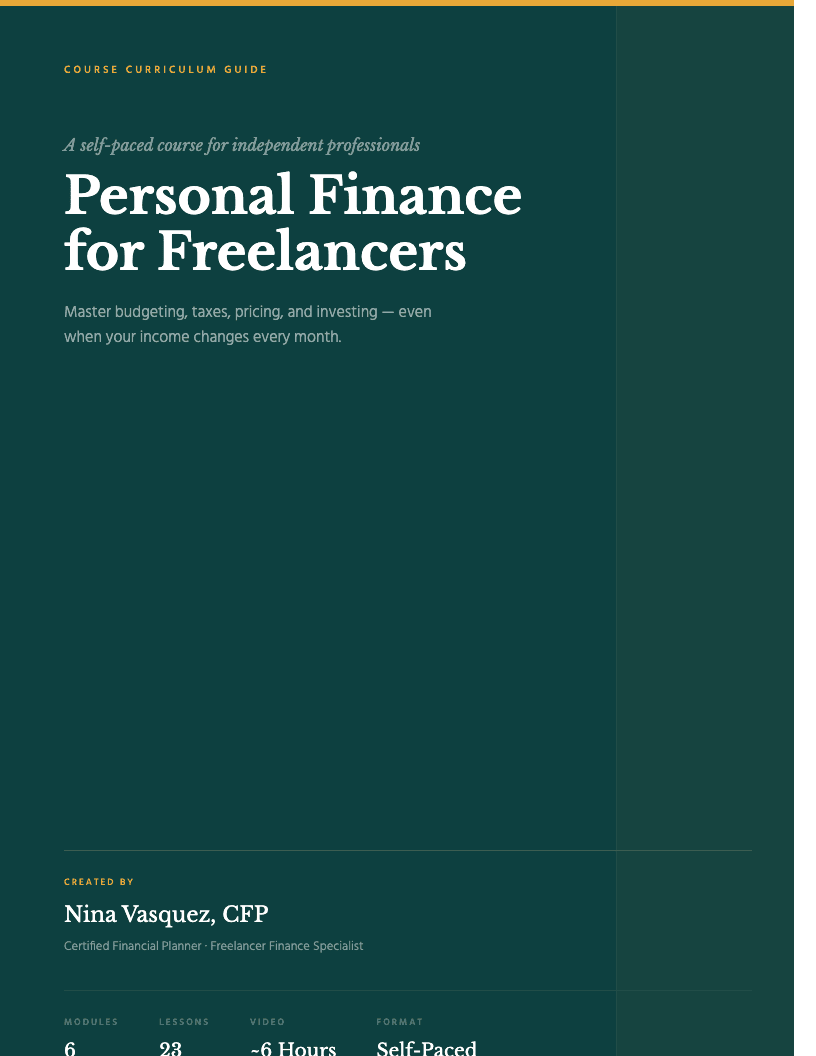
A detailed online course curriculum with 6 modules, learning outcomes per module, lesson lists with durations, and main exercises. Pre-filled with a personal finance course example.
 Education
Executive Coaching Program template
A 12-week leadership coaching program guide with module objectives, biweekly session structure, reflection exercises, and between-session work. Ideal for executive and life coaches.
 Education
Certificate of Completion template
A elegant single-page course completion certificate with decorative border, course name, participant name, completion date, and signature line. Clean and formal design that works for any course.
 Education
Course Workbook template
An engaging workbook template with lesson sections, reflection prompts, lined answer spaces, and a progress tracker. Great for online courses and workshops.
 Education
Lesson Plan template
A complete lesson plan template for teachers. Includes lesson info, learning objectives, materials, a timed procedure table, assessment, and differentiation — pre-filled with a Grade 10 English example.
Browse all 93 free PDF templates
View all templates